
Chemist Notes
Percy Julian: Curiosity, Chemistry, and a Legacy Bigger Than the Laboratory
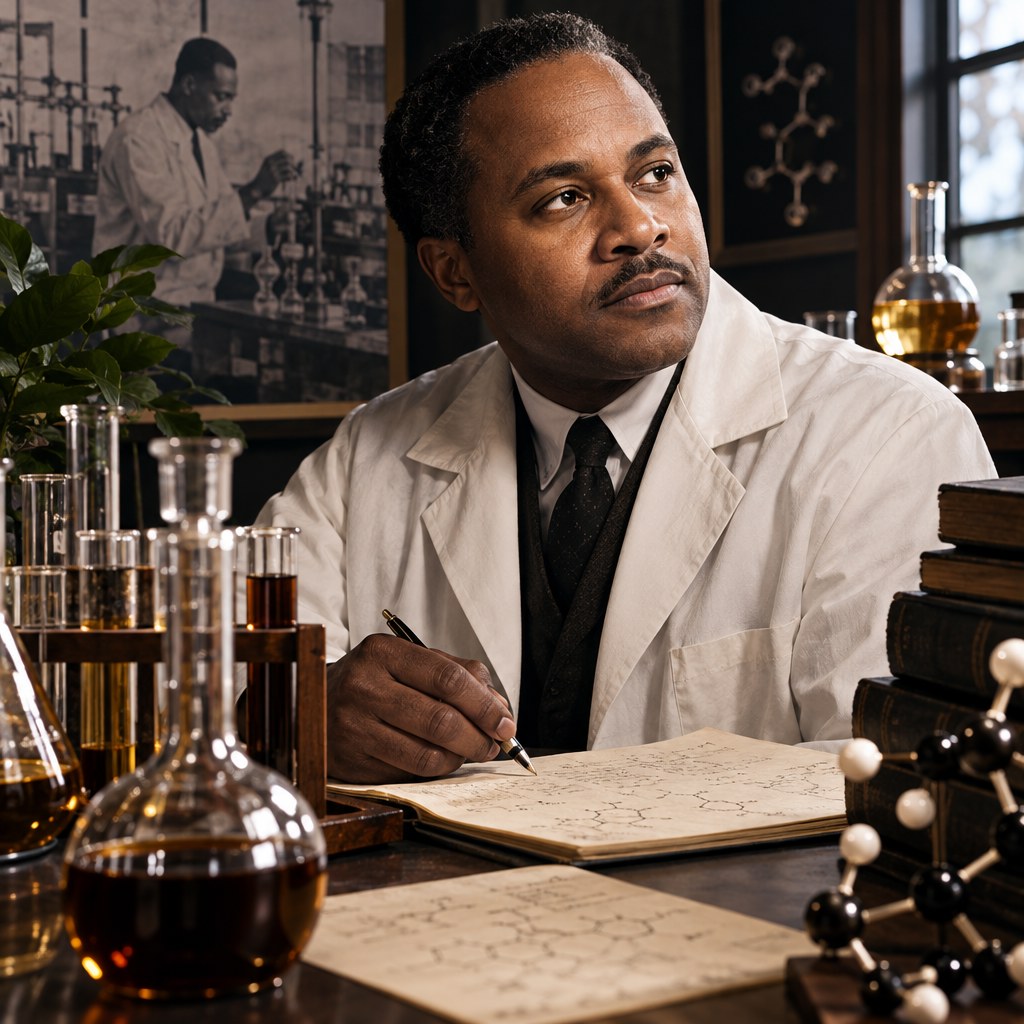
At The Coffee Chemist, the word chemist is about more than a clever name. It points to curiosity, experimentation, discovery, and the belief that science belongs to everyone.
That is why our Minority Scientists series begins with Dr. Percy Lavon Julian, one of the most important American chemists of the twentieth century—and a man whose scientific achievements were shaped by both extraordinary talent and the racial barriers of his time.
A path into science that was anything but simple
Julian was born in Montgomery, Alabama, in 1899. Because educational opportunities for Black students in the segregated South were severely limited, his route to college did not look like the standard path available to many white students of his era.
He entered DePauw University needing to make up academic preparation while also completing college work. He did more than catch up: Julian graduated in 1920 as valedictorian of his class.
He later earned a master’s degree from Harvard University and, after continuing to teach and study, completed his doctorate at the University of Vienna in 1931.
Those milestones matter, but they should not be romanticized as if discrimination simply made him stronger. The barriers were real, unfair, and costly. Julian succeeded despite systems that repeatedly narrowed his opportunities.
The experiment that changed his reputation
In 1935, Julian and chemist Josef Pikl completed the total synthesis of physostigmine, a compound previously obtained from the Calabar bean. The American Chemical Society recognizes the achievement as a landmark in chemistry because it helped make an important glaucoma treatment more accessible.
That work established Julian as a world-class synthetic chemist. Yet scientific recognition did not erase racism. Even with his accomplishments, he was denied an academic faculty position at DePauw.
He moved into industry instead.
Turning plants into practical chemistry
At the Glidden Company, Julian led research involving soybeans and developed processes that produced useful materials from plant compounds. His work contributed to products including a fire-fighting foam used on gasoline and oil fires, as well as methods that made certain steroid compounds more practical to produce.
There is something especially compelling about that part of his career. Julian’s science was not curiosity locked inside a laboratory. It moved outward into medicine, manufacturing, safety, and everyday life.
Over his lifetime, the National Inventors Hall of Fame credits Julian with 88 U.S. patents.
A scientist and a business builder
Julian eventually founded Julian Laboratories in 1953. He later sold the company in 1961 for more than $2 million, a remarkable business achievement for any scientist of that period and especially significant for a Black entrepreneur working in mid-century America.
He continued research, consulting, and advocacy, and in 1973 he was elected to the National Academy of Sciences.
His legacy therefore reaches beyond a single discovery. He was a researcher, inventor, industrial leader, entrepreneur, and advocate for civil rights.
Why representation in science matters
Stories like Julian’s matter because the public image of science has never been neutral. Textbooks, laboratories, advertisements, museums, and product packaging all help shape who people imagine when they hear the word scientist.
When those images repeatedly leave people out, exclusion can start to look like history rather than a choice about what history gets told.
Representation does not mean pretending every scientist had the same experience. It means widening the frame enough to tell the truth: Black scientists, women scientists, immigrant scientists, Indigenous scientists, Latino scientists, Asian scientists, disabled scientists, and many others have contributed to discovery even when institutions failed to make their paths easy.
Curiosity with context
Percy Julian’s story fits The Coffee Chemist because it reminds us that curiosity is powerful—but access matters too.
Talent can exist anywhere. Opportunity does not always follow talent fairly. When we celebrate discovery, we should also ask whose work was overlooked, whose path was made harder, and whose name deserves to be remembered.
That is part of what it means for us to be rooted in culture while staying curious about science.
Keep exploring: If you believe curiosity should include the people behind discovery, read Why Representation on Labels Matters and keep exploring Chemist Notes for more stories at the intersection of science, culture, and representation.
Sources and further reading: American Chemical Society: Percy Lavon Julian and National Inventors Hall of Fame: Percy Lavon Julian.